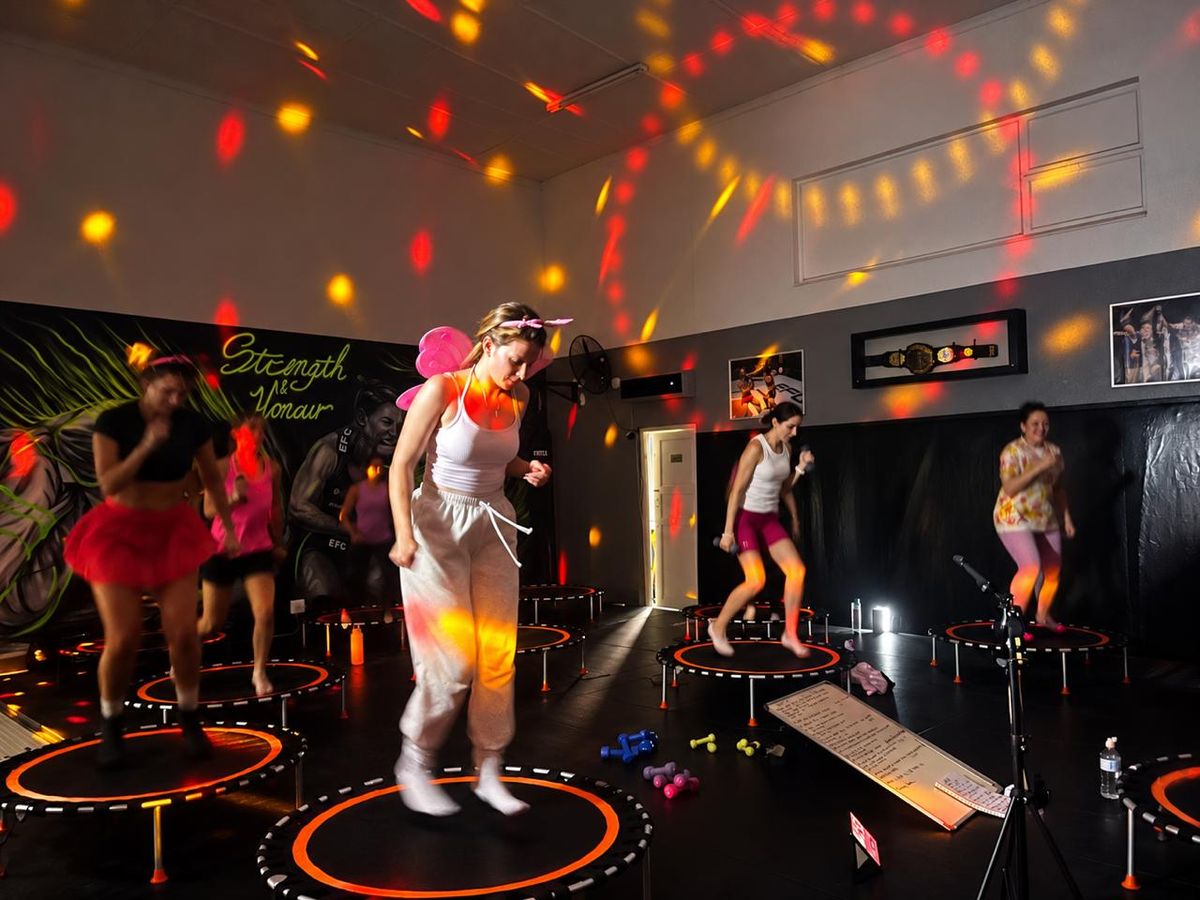
Rebounding, also called bounce fitness or mini-trampoline fitness, looks like play. You bounce, jog and jump on a small trampoline in time to music. But researchers have measured what it actually does to your body, and the results are more serious than the fun suggests. Here is what the studies say about the benefits of rebounding, and what they don’t say. If you want to try it, our rebounding classes in Ballito run on Wednesday mornings, and your first class is free.
What Is Rebounding?
Rebounding is exercise on a rebounder: a small, sturdy mini-trampoline. The springy mat gives under you on every landing and pushes you back up, so simple moves like jogging, jumping jacks and knee lifts become a full-body workout. How hard it is depends on how high and how fast you bounce, which is why the same class can suit a beginner and a fit athlete.
Rebounding Benefits for Your Body
1. It is a real cardio workout
In research sponsored by the American Council on Exercise (ACE) and carried out at the University of Wisconsin–La Crosse in 2016, people did a 19-minute mini-trampoline routine while their heart rate and oxygen use were measured. Heart rates averaged about 79% of maximum, which meets the guidelines for improving cardio fitness.1
2. It burns energy like a run
The same ACE study measured roughly 11 calories a minute for men and 8 for women. A separate 2018 study of overweight women found that one rebounding session of about 46 minutes burned around 317 calories, at about 72% of maximum heart rate.1,2
3. Gentler landings than running on the road
When you land on the mat, it stretches and absorbs part of the impact. A classic 1980 study in the Journal of Applied Physiology compared running with jumping on a trampoline and found the forces were spread more evenly through the body on the trampoline.3 That is why many people find rebounding kinder to their knees, hips and back than running on a hard surface, while still getting their heart rate up. It makes rebounding a good low-impact exercise option.
4. Better balance and stronger legs
Every bounce is a small balance challenge. In a 2019 randomised trial, women aged 56 to 83 with low bone density did twice-weekly mini-trampoline training for 12 weeks. Their one-leg balance improved by about a third, their chair-stand strength improved by 36%, and no injuries were reported.4
5. It feels easier than it is
People in the ACE study rated the workout as easier than their heart rates showed it to be. The researchers pointed out that this matters: exercise that feels manageable is exercise you are more likely to keep doing.1
Rebounding Benefits for Your Mind
A large 2026 review in the British Journal of Sports Medicine pooled 63 randomised trials with around 79,500 people. It found aerobic exercise was one of the most effective kinds of exercise for easing symptoms of depression and anxiety, and that supervised and group exercise worked best for depression.5 The review looked at exercise in general rather than rebounding specifically, but rebounding is an aerobic workout done in a coached group, which ticks both boxes.
The balance trial above also found that fear of falling dropped by 15% as the women got steadier and stronger,4 a real boost to confidence in everyday life. And there is the simple part: an hour of bouncing to music, with other people, where you can’t think about your to-do list.
Rebounding looks like play, but the research shows it is a serious workout that feels easier than it is.
What the Research Doesn’t Show
You will see bold claims about rebounding online. Some are not supported by the evidence, so we don’t make them:
- “NASA found rebounding is 68% better than running.” This figure is often credited to the 1980 study above, but it does not appear in that paper.
- Bone density. In the 12-week trial, balance and strength improved, but the change in bone density was not significant.4
- “Detox” and the lymphatic system. We haven’t found good-quality studies showing rebounding detoxes the body, so we leave that claim out.
Who Should Check With a Doctor First?
Bouncing puts load on the pelvic floor and asks a lot of your balance. If you are pregnant, have recently given birth, or have bladder leaks, a heart condition, or back, knee or balance problems, check with your doctor or physiotherapist before you start, and tell your instructor before the class so you can be shown gentler options.
Try Rebounding in Ballito
At Maddog Performance Institute, rebounding classes are coached by Thalia De Beer of Bounce Ballito Rebound Fitness, a qualified rebounding instructor who has worked in fitness since 2004. You can read about her qualifications on our coaches page.
- When: Wednesdays at 9am, one hour
- Where: 22 Sandra Road, Balvista Centre, Ballito
- Your rebounder is provided, so just bring water and a towel
- Your first class is a free trial. After that, R150 a class, or a 4-class package for R500 (packages are used within 30 days of purchase)
- Bookings are essential, on WhatsApp
Looking for other ways to train at your own pace? See personal training in Ballito or all our training.
Sources
- American Council on Exercise (ACE), research by the University of Wisconsin–La Crosse (2016): Putting mini-trampolines to the test.
- Cugusi L. et al. (2018). Exercise intensity and energy expenditure during a mini-trampoline rebounding exercise session in overweight women. Abstract.
- Bhattacharya A. et al. (1980). Body acceleration distribution and O2 uptake in humans during running and jumping. Journal of Applied Physiology 49(5): 881–887.
- Posch M. et al. (2019). Effectiveness of a mini-trampoline training program on balance and functional mobility, gait performance, strength, fear of falling and bone mineral density in older women with osteopenia. Clinical Interventions in Aging 14: 2281–2293. Full article.
- Munro N.R. et al. (2026). Meta-analysis of 63 randomised trials of exercise for depression and anxiety, about 79,500 people. British Journal of Sports Medicine.
This article provides general educational information and is not a substitute for individual medical advice, diagnosis or treatment.
Your First Rebounding Class Is Free
One-hour rebounding classes with Thalia De Beer on Wednesdays at 9am, rebounder provided. Low-impact, full-body and set to music. Bookings are essential.
Maddog Performance Institute22 Sandra Road, Balvista Centre, Ballito, KZN North Coast
Call / WhatsApp: +27 63 442 1690 · info@maddogperformance.co.za